
How Film Weight Affects Pour Finish and Board Life
A formwork panel's film is a consumable with its own specification. Dongstar Wood publishes two weights — 165 g/㎡ on the smooth surface, 130 g/㎡ on the lighter one — and quotes up to 10–20 reuses for high-grade boards in concrete pouring projects, which makes film choice a board-life decision.
Key takeaways
- Two film weights are published: 165 g/㎡ smooth and 130 g/㎡, and the heavier film is the one matched to repeated pours.
- The reuse ceiling belongs to the high-grade board: 10–20 pours on concrete work, against roughly 3–5 for the ordinary black variant.
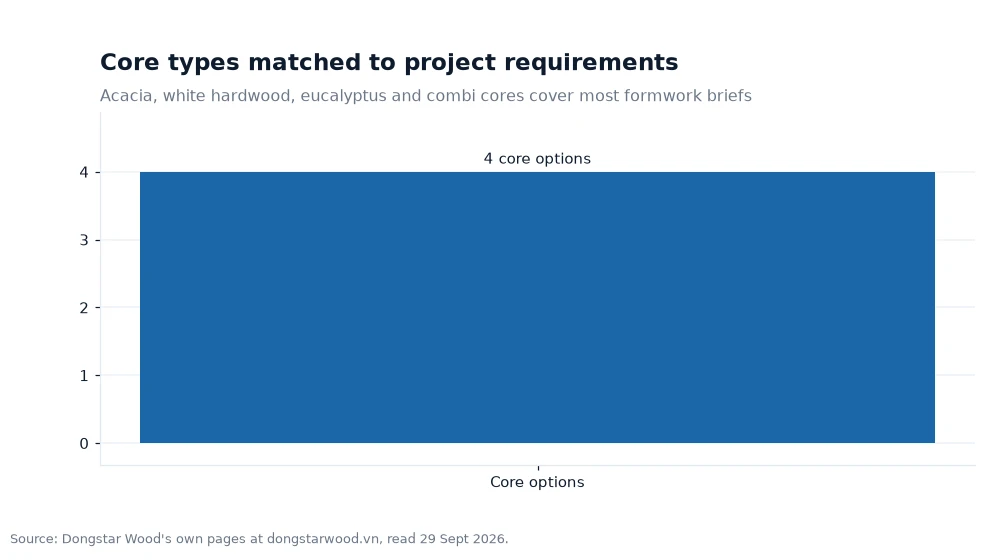
- The core list runs six deep: Birch, Eucalyptus, Acacia, White Hardwood, Rubber and Combi, so the core can be matched to the pour.
- The range steps up at 18 mm for demanding pours, and again at 21 mm where a deck has to span or carry platform loads.
What the film actually does
A formwork plywood panel meets wet concrete at pressure, and the film is the only part of the board that touches the pour. The cement paste never bonds to the veneer because of it, the release agent it carries lets the panel strip cleanly, and it absorbs the abrasion of vibrators, trowels and the concrete itself. A heavier phenolic film simply survives more of that contact before it wears through.
Two weights are published: the smooth surface carries 165 g/㎡, the lighter option 130 g/㎡. The gap is functional rather than cosmetic — a thicker film shrugs off more handling cycles, harder edge contact and more aggressive release, so the boards built for reuse carry the heavier specification.
Reuse cycles and what limits them
According to the category page, high-grade film faced plywood can survive 10–20 pours on concrete projects. That range is not a promise about a specific board; it is the envelope that good practice produces. The ordinary black variant, by contrast, is typically reused approximately 3–5 times under normal site conditions, which positions it as the economical option for shorter programmes.
What ends a board's life is rarely the film wearing out in the middle. Edges go first — they get knocked, soaked and levered — and surface damage follows where panels are dragged across rough formwork. A board that is dragged rather than carried wears at the contact points first, which is why the published reuse range is stated as a range rather than a single figure. Sealed edges and careful handling are what move a board toward the top of that range rather than the bottom.
Cores behind the film
Six cores are offered on the film faced range: Birch, Eucalyptus, Acacia, White Hardwood, Rubber and Combi. The Acacia option is a high-density hardwood chosen for load-bearing work. Eucalyptus Core delivers maximum compression resistance and bending strength. The Combi Core hybrid balances strength, weight and cost, while the white hardwood option — species like Bodhi or mixed light hardwoods — is positioned on stability and balanced mechanical strength.
The core choice changes how the panel behaves under a wet pour. A dense hardwood core resists the pressure of fresh concrete and keeps the face flat; a hybrid core saves weight where the formwork is handled by hand. The film gets the glory, but the core is what keeps the panel square through ten cycles.
Thickness for the load
The published thickness guidance splits the range in two. General pouring sits at 18 mm, the heavy formwork choice and best all-round option. Bridges and high-load platforms belong to 21 mm and above, where the panel spans further and carries more than just wet concrete.
The published standard sheets are 1500 × 3000 mm, 1220 × 2440 mm and 1250 × 2500 mm, and the mill will cut custom panels as large as 1830 × 3830 mm. Dividing a formwork area into panel counts starts from the base figure of 1.22 × 2.44 = 2.9768 m² for each standard sheet. That spread of widths gives a specifier room to choose: narrow sheets suit column forms, wide sheets suit slab pours, and non-standard geometry falls to the custom range.
Glue classes and film colours
The adhesive list runs E0, E1, E2, MR, WBP and Phenolic Dynea. For formwork duty, the phenolic and WBP systems are the relevant ones: they keep the veneer layers bonded through repeated wetting, drying and the heat of curing concrete. The film surface itself is offered in dark brown, black and anti-slip versions, the last of them for platforms and walkways where grip matters as much as release.
The glue and the film are specified together, not separately. A board bonded for dry interior use and then sent to a pour will delaminate at the edges long before the film wears, because the adhesive system was never designed for the wet cycle.
| Film and board variable | Published option | Practical effect |
|---|---|---|
| Film weight | 165 g/㎡ / 130 g/㎡ | Heavier film suits repeated pours |
| Reuse | 10–20 times / 3–5 times | High-grade versus ordinary black |
| Cores | Birch, Eucalyptus, Acacia, White Hardwood, Rubber, Combi | Strength, weight, cost balance |
| Thickness | 18 mm / 21 mm+ | General formwork / bridges and platforms |
| Adhesives | E0, E1, E2, MR, WBP, Phenolic Dynea | Bond system matched to exposure |
Worked example: contact area per sheet over its life
Board life becomes a number once reuse is multiplied out. A 1250 × 2500 mm sheet covers 1.25 × 2.5 = 3.125 m² per face. At 10 reuse cycles, one sheet delivers 10 × 3.125 = 31.25 m² of formwork contact area over its working life. A 100 m² wall pour therefore needs 100 ÷ 31.25 = 3.2 sheets across its life, so four boards cover the pour ten times over.
The same arithmetic explains the two product families. An ordinary black board reused 3–5 times delivers 3 × 3.125 = 9.375 to 5 × 3.125 = 15.625 m² of contact area, which is why it is positioned as the economical option for shorter programmes rather than a false economy on a long one.
Frequently asked questions
What does the film weight number mean?
It is the phenolic film's mass per square metre: 165 g/㎡ on the smooth surface, 130 g/㎡ on the lighter option. Repeated pours get the heavier film, since it tolerates more handling and abrasion before it wears through.
How many times can a formwork panel be reused?
Reuse is counted in pours, not years: the category page puts high-grade film faced plywood at 10–20 cycles on concrete work, with the ordinary black variant typically managing about 3–5 under normal site conditions. Where a board lands inside that span depends on edges and handling.
Which thickness should a bridge deck use?
21 mm and above is the published recommendation for bridges and high-load platforms, with 18 mm the heavy formwork choice for general pouring. The core should be named explicitly, since the same thickness can be built on different cores.
Matching the board to the pour programme
Film weight, core, thickness and glue form one decision, not four. Read the Film Faced Plywood category page for the current film, core and adhesive options, then check the company profile for the factory figures behind them. Where the programme is short and the budget tight, the ordinary black range covers the economical end of the same duty. A formwork budget priced on board life rather than board price is the one that survives the programme.
The data behind this article was taken from Dongstar Wood's own site examined 29 Sept 2026[1].