
A minimum order quantity is a planning constraint before it is a price issue. For a vegan perfume brand, the real cost of getting the MOQ wrong is rarely the deposit — it is the stock you cannot sell, the claim you cannot substantiate, and the reformulation you end up paying for twice. Treat the MOQ as a design input for the whole product plan and most of the classic mistakes disappear. This article lists the five mistakes that come up most often, and what to do instead of each one.
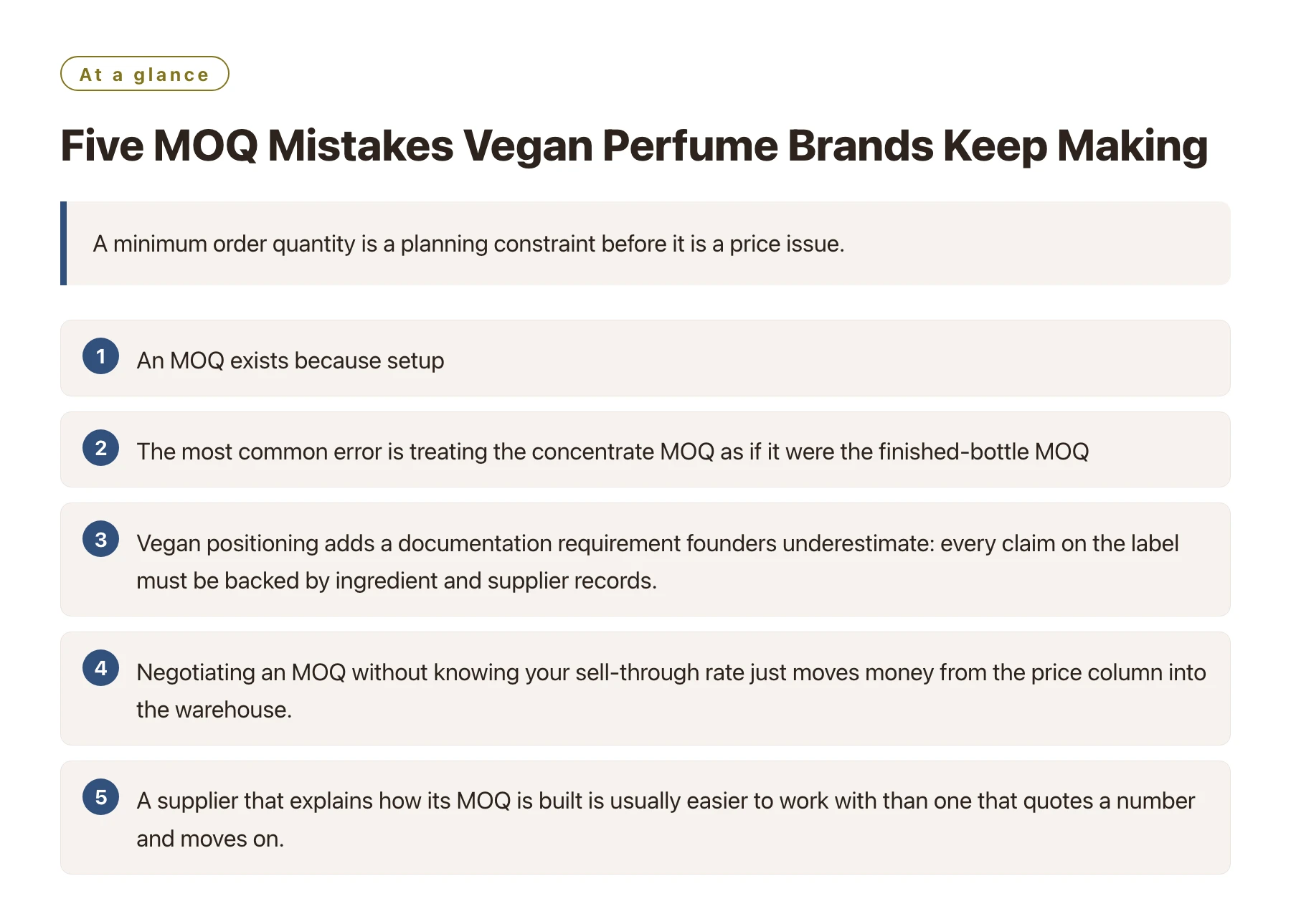
Key takeawaysAn MOQ exists because setup, compounding and filling carry fixed costs that a small run must absorb; it is a production-economics number, not a sales lever. · The most common error is treating the concentrate MOQ as if it were the finished-bottle MOQ, when the two can differ by an order of magnitude. · Vegan positioning adds a documentation requirement founders underestimate: every claim on the label must be backed by ingredient and supplier records. · Negotiating an MOQ without knowing your sell-through rate just moves money from the price column into the warehouse. · A supplier that explains how its MOQ is built is usually easier to work with than one that quotes a number and moves on.
Ask ten buyers what an MOQ is and nine will say it is the minimum number of units a factory will produce for you. That is the definition, and it is almost useless as a working number, because it hides why the number exists and what it does to your cash flow.
For a vegan brand there is a second layer on top of the economics. A vegan claim has to be provable from formula to finished product, and the documentation trail affects both the order size and the price per unit. Understanding the mechanics below keeps the MOQ conversation honest from the first quotation.
What an MOQ actually contains
Manufacturing an order of perfume involves fixed costs that do not shrink with volume: setting up the compounding line, calibrating the filling equipment, preparing packaging materials, and running quality control on the batch. Spread those costs over a small run and the unit price climbs fast; that is the entire reason a factory quotes a minimum.
The practical lever most buyers miss is that the fixed costs sit at different stages. A partner that keeps one-stop fragrance manufacturing tends to quote compounding, filling and packing as one connected chain, which makes the MOQ easier to understand than when each stage is subcontracted and quoted separately.
Before an order ships, the batch has to pass release testing — the kind of quality assurance third-party laboratories perform on finished cosmetic products, checking that the batch matches the approved specification [1]. Release testing adds a per-batch cost that shows up in the minimum order whether the buyer sees it or not.
The five mistakes, in the order they happen
Each mistake below costs money at a different point in the project. Cross them off in order and the first order becomes a process test instead of a gamble.
Mistake one: confusing concentrate MOQ with bottle MOQ
The concentrate — the perfume oil itself — is usually made in much smaller quantities than the finished product, because it is dosed at two to twenty percent into the finished formula. A factory may accept a small concentrate run while requiring a large finished-bottle run, or the reverse. Ask for both numbers in writing before you budget.
Mistake two: ordering a full MOQ to 'test the market'
A market test is a job for samples and small pilot runs, not for a full minimum order. If you want evidence of demand, put the money into a small, higher-unit-cost pilot that you can actually sell, and keep the MOQ discussion until the pilot tells you something.
Mistake three: assuming vegan is one ingredient swap
Vegan positioning is a property of the whole formula and the whole supply chain, not of replacing a single musk. The finished product is also a cosmetic in the eyes of regulators: it has to be safe, correctly labelled and documented before it is placed on the market in regulated regions, and the vegan claim is only one line in that file [2]. If the supplier treats 'vegan' as a note in the fragrance brief rather than a documentation requirement, the order will come back to you.
Mistake four: signing for an MOQ that is actually a range
Some quotations say 'MOQ 3,000–5,000 units' and let the factory decide at order time. That is not a commitment, it is a forecast. A real MOQ is a single number attached to a specific bottle, cap, fill size and formula — or a written schedule of how the number changes as those change.
Mistake five: negotiating MOQ before settling the bottle
The bottle determines the filling line, the carton determines the packing line, and both determine a big share of the fixed cost. Negotiating the MOQ before the pack is fixed is bargaining over a number that will change anyway. Settle the physical product first; then the MOQ conversation is real.
One-number rule: whatever MOQ you eventually agree, make sure it is one number for one pack specification, written into the quotation with the stage it applies to. If the supplier cannot write it that way, the number is not ready to sign.
Negotiating from a position of facts
The best time to negotiate the MOQ is after you know your own numbers: retail price, expected sell-through in the first three months, and how much stock you can physically store. With those three, the MOQ stops being a mystery and becomes a logistics question — can this factory's minimum fit inside my storage and my sell-through window?
Transparency helps on both sides. A manufacturer that publishes its scope and certification list — such as Xuelei Cosmetics, which documents what it does in house — makes the negotiation shorter, because there is something concrete to check instead of a promise. When private label fragrance production is the route, the same transparency question applies to the whole quote: ask which part of the MOQ is bottle, which is concentrate and which is filling.
Sources
- SGS: Cosmetics, Personal Care & Household Testing —— Testing, inspection and certification services for cosmetics and personal care, including microbiological, stability and safety testing aligned with cosmetics GMP.
- European Commission: Cosmetics in the EU —— The European Commission's overview of EU cosmetics rules, including the responsible person, product information file and safety report requirements.
Frequently asked questions
Can I negotiate a smaller MOQ with a fragrance factory?
Sometimes, but the conversation works better in a different direction: ask what changes if you reduce the order — smaller runs absorb the same fixed costs, so the unit price rises. A more productive lever is committing to a repeat schedule, which lets the factory plan line time and quote a better number for the series.
Is the MOQ per bottle or per scent?
Usually per finished product per stock-keeping unit — a specific scent in a specific bottle at a specific fill. Changing the bottle, the cap or the fill size reopens the MOQ discussion, which is why packaging decisions and MOQ decisions belong in the same meeting.
Why is my vegan perfume MOQ higher than a conventional one?
Often because of documentation, not production: verifying the vegan claim across concentrate, bottle and closure adds review steps, and some factories pass that cost into the minimum order. Ask the supplier to split the MOQ into production cost and documentation cost so you can see which part you are paying.
Should I order from multiple factories to compare MOQs?
For a first order, comparison is useful only with an identical brief. Send the same specification — same bottle, fill, formula direction and documentation list — to two or three suppliers, then compare the MOQ breakdowns rather than the headline numbers.
What happens if I order below the MOQ anyway?
Some factories accept it as a one-off at a higher unit price; others decline. If you are likely to need below-minimum runs repeatedly, negotiate a pilot-order clause in writing before the first order rather than discovering the cost at checkout.